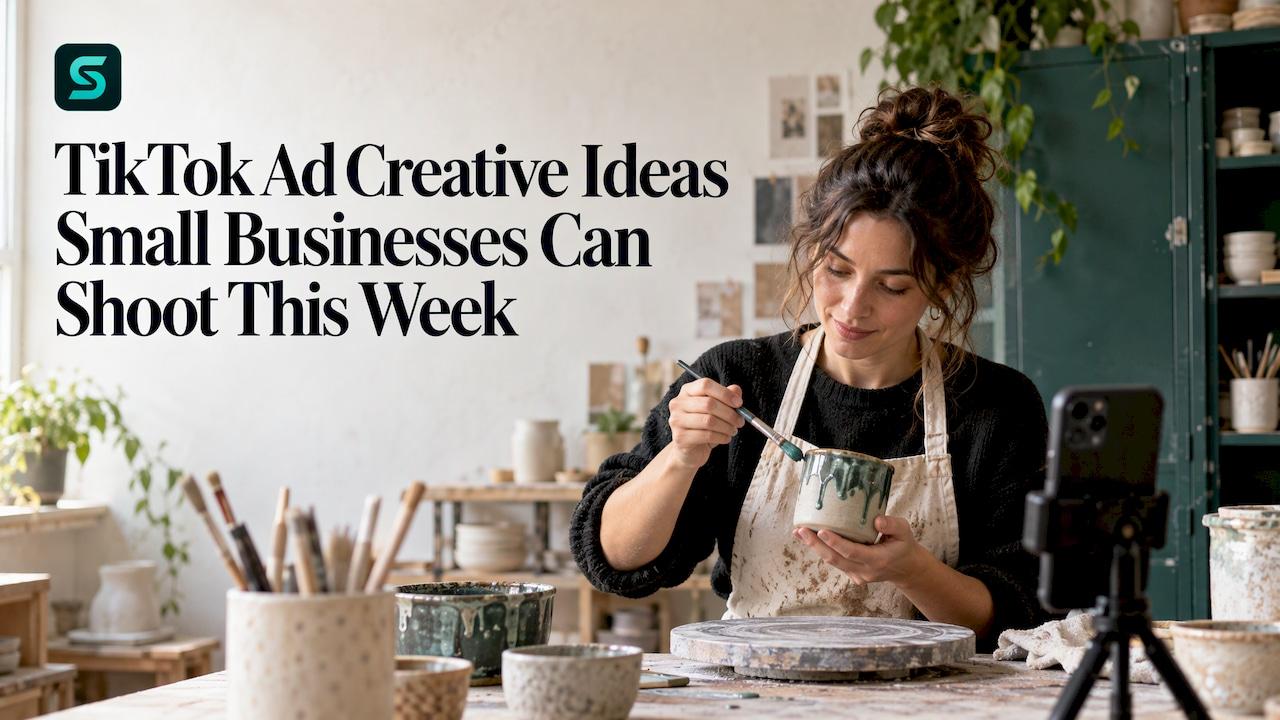
The best TikTok ad creative looks like TikTok: a human face or a surprising action in the first seconds, one clear product moment in the middle, and a single call to action at the end. You do not need a studio. You need a handful of repeatable ideas, several versions of the opening, and a way to test them quickly. Below are twelve ideas you can film on a phone, the structure that holds them together, the specs to check, and how AI can speed up the busywork.
TL;DR
- Build every ad as hook, body and close. Put your strongest visual or statement in the first three seconds.
- Native formats such as creator-style reviews, founder stories, green-screen explainers and before-and-after reveals suit small budgets.
- Film several hook variations per idea, keep the rest of the ad the same, and replace the hook when it tires.
- Mix entertainment (faces, story, music) with selling (product, offer, call to action). The strongest short-form ads do both.
- AI can draft scripts, storyboards and variants, but you still approve the message and the spend.
Table of Contents
- What makes TikTok ad creative work
- Twelve TikTok ad creative ideas to adapt
- Small-business examples worth copying
- Write a hook that holds
- Body and close: show the product, then ask once
- Check formats and specs before you export
- Test your creative without wasting budget
- Using AI to make TikTok ads faster
- Our perspective
- Turn these ideas into ads with Soclo
- FAQ
- Sources
What makes TikTok ad creative work
Start with structure, because every idea below plugs into it. TikTok's own Creative Codes describe an effective ad as a hook, a body and a close: grab attention, keep people watching with a story, then end on a clear call to action.
Search Engine Land's production framework puts rough timings on it: a hook from 0:00 to 0:03, a body from about 0:04 to 0:15, and a final 3 to 5 seconds for the call to action. That makes a tight ad of roughly 15 to 20 seconds, which is a practical target for a first batch.

Why the hook gets so much attention: TikTok's Value of View research, as reported by Superside, found that about 90% of ad-recall impact is captured in the first six seconds. Treat the opening as the whole job of the first draft.
Entertain and sell in the same ad
System1 and TikTok research separates showmanship from salesmanship. Showmanship means characters, unfolding stories, expressive faces, music and novelty. Salesmanship means facts, comparisons, product focus and calls to action. Its conclusion: showmanship builds brands, salesmanship converts, and the strongest short-form ads combine both.
In practice, open with the human or surprising moment, then show the product doing something, then ask for the click.
There is also a trust angle. The Ipsos and TikTok Return on Creative study reports that 83% of TikTok viewers say they trust brands seen in TikTok-first ads, and that 28% of users say storytelling would likely get their attention while scrolling.
Twelve TikTok ad creative ideas to adapt
Exposure's teardown of TikTok-native ad patterns lists the formats viewers already recognize. Here are twelve built from those patterns and from the small-business examples further down, with a note on how a small business can use each.
- The honest creator review. Someone talks to camera about what they actually use the product for, including a quirk. Works for products with a clear everyday use.
- The founder story. You speak to camera for about 20 seconds on why you started, then make a low-risk offer. More on this below.
- Get ready with me (GRWM). Show your product inside a routine: a morning at the salon, a barista setup, a packing session.
- POV caption. Frame the scene from the customer's eyes: "POV: your pipes just froze at 6 a.m." Use it to name a problem in one line.
- Street or shop-floor interview. Ask a customer or passer-by one question about your category and use the most interesting answer as the hook.
- Green-screen explainer. Stand in front of a headline, review or screenshot and explain it. Good for services that need a quick "here is how it works."
- ASMR or texture demo. Crunch, pour, scrape, zip. Sound-led product moments suit food, beauty, tools and craft goods.
- Numbered listicle. "3 mistakes people make with X." The number promises a short, finished ad.
- Confessional talking head. A plain admission ("I almost closed the shop last year") invites people to stay for the turn in the story.
- Before and after. Cleaning, renovation, styling, fitness, design. Show the result first, then the process.
- Duet or stitch reaction. React to a comment, a question or another video from your own account.
- Comment-led series. Answer a viewer's question in a follow-up video. Zapier's TikTok ad examples include a product demonstration where the narrator asks viewers if they want an example, then follows up in response to comments.
Pick two, not twelve
A small account does better with two or three formats made well than twelve made thinly. Choose the formats that match what you sell:
| If you sell... | Start with | Why it fits |
|---|---|---|
| A physical product with a sensory appeal | ASMR or texture demo, before and after | The product does the talking |
| A local service | Founder story, POV caption, behind the scenes | Builds trust with nearby buyers |
| A digital product or software | Green-screen explainer, numbered listicle | Explains value quickly |
| A personal brand or creator offer | Confessional talking head, comment-led series | Personality is the product |
Small-business examples worth copying
These are concrete examples from published write-ups. Treat them as patterns to adapt, not results to expect.
A founder-led story with a surprising frame. HubSpot's account of CandeezeCo describes a freeze-dried candy business whose videos open clearly, use the founders' wedding as an unexpected frame, show the freeze-drying process, add a crisp ASMR crunch, and only then suggest a purchase once trust has been built. The lesson: earn the pitch.

A founder-to-camera Spark Ad. Labile Consults describes a small coffee roastery where the founder speaks to camera for 20 seconds about why they started, then offers a bag for £1 shipping. The write-up notes that boosting an organic founder-led video keeps its likes and comments attached, so the ad starts with social proof.
A behind-the-scenes local campaign. A boutique fitness studio case study from Sagum used smartphone behind-the-scenes footage, a 5-mile radius and offer-led calls to action, and reported 84 direct bookings in 60 days. These figures come from the agency's own write-up, so use them as inspiration for the approach rather than a benchmark.
Write a hook that holds
The hook is where most ads fail, so spend your creative time here. Superside's review of TikTok ad creative suggests the opening can be a bold statement, a question, an unexpected visual, a human face, suspense or movement.
Five hook formulas you can adapt in minutes:
- The result first. Show the finished transformation, then rewind.
- The direct question. "Why does your coffee taste flat by Thursday?"
- The mid-action start. Begin with the pour, the cut, the crash or the reveal already happening.
- The contrarian line. "Stop buying a new filter every month."
- The specific audience call-out. "If you run a salon alone, watch this."
Film more openings than you think you need
Search Engine Land recommends filming five to seven hook variations per concept, using pattern interrupts such as starting mid-action, zooming in or throwing an object. Keep the body and call to action, and swap in a fresh hook when the current one fatigues.
It is cheaper than reshooting whole ads, and it fits how short the shelf life of TikTok creative is.
Body and close: show the product, then ask once
In the body, demonstrate. Do not describe your product when you can show it working. Keep edits tight, add captions (many people watch in noisy places, and captions also help silent viewing), and use sound deliberately.
In the close, ask for one thing. A strong call to action names the action and the reason: "Book your first class this week" beats "Learn more." If your calls to action tend to be ignored, our guide to what a call to action is and why yours may not work covers the usual fixes.
For a scripting template you can shoot as is, see our 30-second video ad script walkthrough.
Make it feel native
UGC-style content, filmed by a real person on a phone, tends to suit the platform better than polished studio footage. If you want other people to make that content for you, our creator brief and FTC checklist shows how to brief creators and keep the disclosures right.
Check formats and specs before you export
TikTok ads mostly come in two flavors. In-Feed ads appear in the For You feed. Spark Ads amplify an existing post, with the creator's authorization if it is not your own account.
For in-feed ads, Influee's spec guide lists 9:16 as the recommended ratio, a 540×960 minimum resolution, 5 to 60 seconds, a 500MB maximum, common file types such as MP4 and MOV, a 12 to 100 character caption and a 2 to 20 character brand name. Specs change, so confirm them in TikTok Ads Manager before you export.
Two practical rules hold regardless of the exact numbers. Shoot full-screen vertical, and keep faces and text away from the top and bottom edges where the interface sits. Shorter usually beats longer: Web Tonic's 2026 local-services data reports that creative over 40 seconds costs more per impression and converts worse, though that is one agency's dataset.
Test your creative without wasting budget
Testing is how a small advertiser competes with a bigger one. Chase Sagum, writing in May 2026, argues that TikTok rewards specificity over volume and that speed of iteration matters more than budget size: test fast, cut losers early, and double down on winners.
A simple test plan:
- Pick one offer and one audience. Do not change them between versions.
- Make three versions with different hooks. Same body, same call to action.
- Run them side by side for about a week. TikAdTools' restaurant guide suggests a daily test budget of $20 to $50 for this kind of test.
- Compare view-through and click rate. Keep the winner, retire the others.
- Refresh the hook, not the whole ad, when results slip.
- Boost what already works organically. Spark Ads let a post that earned real comments carry that proof into paid delivery.
One caution from Web Tonic's franchise data: optimize toward the result you actually get paid for, such as bookings or sales, not only clicks or cheap leads.
Using AI to make TikTok ads faster
AI helps most with the slow parts: scripts, variations and first cuts. TikTok's own Symphony tools show where the category is going. The Keyword reports that Symphony Agent can go from a brief, product image or reference video to an insight summary, storyboard and generated video, with changes to voiceover, tone, scenes and calls to action, and can produce up to three versions at a time for comparing messaging, characters or visual styles.
The workflow worth copying, whatever tool you use:
- Describe the product, the audience and the one outcome you want.
- Ask for several hooks and short scripts built on hook, body and close.
- Generate a first cut, then edit for your real voice, real product and real claims.
- Make two or three variants and test them as above.
AI speeds up drafts. It does not replace your knowledge of customers. Review every line before it runs, especially anything that makes a claim about results.
Our perspective
Most small teams do not lack ideas. They lack a way to turn an idea into a finished, consistent campaign before the moment passes.
That is why we built Soclo around plain English. You type what you want, such as "a 15-second ad showing our new seasonal menu, friendly tone," and Soclo's AI generates the ad, video or post in your voice and brand. We use multiple AI models behind the scenes, so you never have to pick an engine or tool.
We also think you should stay in charge. Soclo keeps approvals and spending in your hands, and Autopilot handles scheduling and posting so your content stays consistent without taking over your week.
For TikTok-style creative, that means you can try five hooks for one concept in the time it used to take to storyboard one, then put your attention on the part only you can do: telling the truth about your business on camera.
simeon
Turn these ideas into ads with Soclo
If you want to go from idea to finished creative without juggling separate tools, Soclo's AI content and advert studio generates ads, videos and posts from a plain-English prompt. You can start from our content templates or plan the whole campaign with the strategy planner.

Once the ads are live, Soclo Ads and Ads Watch helps you manage ads across networks with budget controls, and Autopilot schedules and posts your content. Plans start with a Free tier at £0 per month, then Starter at £7.99 per month, Pro at £19.99 per month, Business at £49.99 per month and Autonomy at £99.99 per month. Credits for advanced features such as voice and music start from £1.99 one-off. See current details on the pricing page.
If you also want to understand how video fits your wider plan, read whether your business needs to post video and whether it needs to be on TikTok.
FAQ
How long should a TikTok ad be?
For most small businesses, aim for roughly 15 to 20 seconds. A common production framework gives the hook the first three seconds, the body about 12 seconds, and the final few seconds to the call to action. Ads can run longer, but a shorter ad forces you to cut everything that does not earn its place.
Do I need a studio or professional video to run TikTok ads?
No. Phone-shot, creator-style footage with clear audio and good lighting suits the platform, and several published small-business examples rely on smartphone behind-the-scenes footage. Film vertical at 9:16, check the current specs in Ads Manager, and put your effort into the hook and the story.
Can I make TikTok ads with AI?
Yes. AI tools can draft scripts, generate storyboards and produce video variants from a brief or product image. With Soclo, you describe the ad in plain English, review what it creates, and approve it before it runs. Always check the output for accuracy and your own voice.
What is the difference between In-Feed ads and Spark Ads?
In-Feed ads are created in Ads Manager and appear in the For You feed. Spark Ads promote an existing organic post, from your account or from a creator who authorizes it, so the post's likes and comments stay attached. Spark Ads are a good way to put budget behind content that has already landed with viewers.
How many ad variations should I test?
Start with three versions of one concept that differ only in the hook, with the same offer and call to action. Run them side by side for about a week, keep the winner and replace the rest. Filming five to seven hook options per concept gives you a bench to draw from as ads tire.
Sources
- Advida: Creative Codes, 6 principles for creating on TikTok
- Search Engine Land: TikTok ad creative has a shorter shelf life
- System1: The Long and the Short (form) of It
- Ipsos and TikTok: Return on Creative
- Exposure: 12 TikTok ad examples that convert
- Zapier: 8 TikTok ads examples to spark campaign ideas
- HubSpot: How to launch your product to a crowd of 32 million on TikTok
- Influee: TikTok ad specs
- Sagum: TikTok ad case studies for small businesses
- The Keyword: TikTok Symphony Agent powers creative studio video ads