
A social media growth strategy is a short, written plan that says who you want to reach, where, with what content, how often, and how you will know it is working. Most accounts stall because they skip one of those five parts, usually the last. Below is a plan a small business owner, creator or freelancer can set up in an afternoon and run on a few hours a week.
TL;DR
- Pick one measurable goal and one audience before you touch a content calendar.
- Go deep on one or two platforms where your customers already spend time, rather than posting everywhere.
- Build 3 to 4 content pillars, then repeat and remix them on a steady schedule.
- Spend as much time engaging with other accounts as posting your own content.
- Review the numbers every 30 days and run the plan for at least 90 days before changing course.
Table of Contents
- Start with one goal and one audience
- Choose platforms where your audience already is
- Build content around a few repeatable pillars
- Post on a rhythm you can keep
- Engage like a person, not a broadcaster
- Turn followers into customers
- Measure, review and adjust every 30 days
- Our perspective: control matters more than volume
- Put the plan on rails with Soclo
- FAQ
- Sources
Start with one goal and one audience
Growth is not the same as a bigger follower count. A follower count is a vanity number unless it connects to something you can bank: enquiries, bookings, newsletter sign-ups, sales. Pick one primary goal for the next 90 days and write it as a number with a date.
Weak goal: "grow on Instagram."
Useful goal: "Get 25 booking enquiries from Instagram and LinkedIn by the end of January."
Then describe the one person you want to reach. Not "small business owners," but "owners of independent gyms with fewer than 200 members who are tired of posting inconsistently." The narrower your description, the easier every later decision becomes: which platform, what to say, which accounts to engage with. Several of the guides that rank for this topic, such as Search Engine Journal's follower guide, put clear audience definition and regular analysis at the core of growth, and for good reason: everything else depends on it.
A quick exercise: write down the three questions your customers ask you most often. Those are your first three posts, and probably your first three content pillars.
Choose platforms where your audience already is
You do not need to be everywhere. You need to be where the people in your description already spend their time.
The scale of the opportunity is large. DataReportal's Digital 2026 report counts 5.66 billion active social media user identities worldwide as of October 2025, about 68.7% of the global population. The same report finds that TikTok users spend the most time per day, at 1 hour 37 minutes, ahead of YouTube at about 1 hour 23 minutes and Instagram at 1 hour 13 minutes.
In the United States specifically, Pew Research Center's 2025 survey shows YouTube and Facebook remain the most widely used platforms, with 84% and 71% of U.S. adults saying they ever use them. Roughly half of U.S. adults visit each of those two daily.
Use numbers like these as a starting filter, not a verdict. A platform with a huge audience is useless if your buyers are not on it. A rough rule of thumb:
| If you sell to... | Start with | Why |
|---|---|---|
| Local consumers (salons, cafés, fitness) | Instagram, Facebook | Local discovery, visual proof, easy messaging |
| Other businesses or professionals | Decision makers, longer posts, referrals | |
| A younger or entertainment-minded audience | TikTok, YouTube Shorts | Short video discovery beyond your followers |
| Expertise-led creators and educators | YouTube, plus one short-video channel | Searchable, long shelf life |
Commit to two platforms for 90 days. If one of them is short-form video, our YouTube Shorts strategy guide covers how to structure a plan there, and if you sell to businesses, what a small business should post on LinkedIn gives you specific post types.
Build content around a few repeatable pillars
Blank-page syndrome kills more social strategies than bad ideas do. The fix is pillars: three or four recurring themes that every post fits into.
A good starter set for a service business:
- Teach. Answer one customer question in under a minute.
- Show. Before and after, behind the scenes, a real job or product in use.
- Prove. A customer result, a review, a number.
- Invite. A direct offer, a booking link, a question for your audience.
Split your week roughly 40% teach, 30% show, 20% prove, 10% invite. That ratio is a starting point, not a law. Adjust it after your first review.
Then reuse ruthlessly. One customer question can become a short video, a carousel, a LinkedIn post and a story. The idea is to make a small number of ideas travel further, not to invent new ones daily.

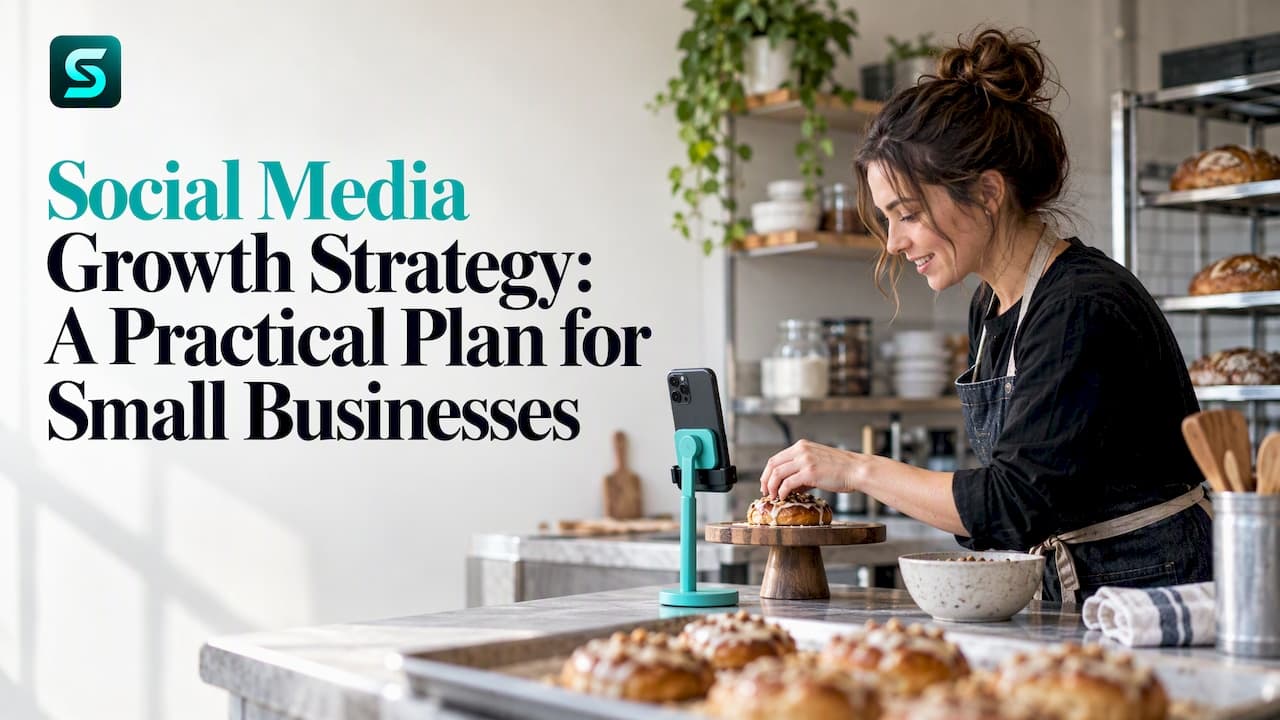
Video deserves special mention because short-form video gets the most time on the biggest platforms. You do not need a studio. Some teams set up a small in-house TikTok corner with a phone stand, decent light and a clean background so filming takes minutes instead of a whole afternoon. Good light and clear audio matter more than any equipment upgrade.
If you want help with drafting, AI can speed up the first version, as long as a human keeps the voice and checks the facts. We cover the trade-offs in should you use AI to write your social media posts.
Post on a rhythm you can keep
Consistency beats intensity. Posting daily for two weeks and then vanishing for a month teaches platforms and followers nothing. Posting three times a week for six months teaches them to expect you.
Pick a frequency you can sustain on your worst week. For most small teams that is:
- 3 posts per week on your main platform
- 2 posts per week on your secondary platform (often a repurposed version)
- Daily 10-minute engagement sessions (more on that below)
On timing, resist the urge to chase a universal "best hour." Your own analytics are better than any industry chart. Start with a sensible guess and test it, and our guide to the best time to post on social media explains how to read your own data.
Batching helps. Set aside one 90-minute block per week to write, film and schedule everything. Scheduling is also where automation earns its place. If you plan to automate, keep a person in the approval loop; see how to automate social posting safely with human review. And if you use AI-generated material, check how to schedule posts and handle AI disclosure on each platform.
Engage like a person, not a broadcaster
An account that only posts is a billboard. Growth comes from conversations, and the cheapest growth tactic available is showing up in other people's comment sections.
The Jetpack guide to growing followers lists commenting on larger accounts in your niche daily and using collaboration posts among its top tactics, and it claims that sticking with even four or five of its 16 for 90 days should produce measurable gains in reach and engagement. Treat that as the publisher's claim rather than a guarantee, but the tactics themselves are sound and cost only time.
A daily 10-minute routine:
- Reply to every comment and direct message on your own posts.
- Leave five thoughtful comments on posts from accounts your ideal customer follows. Add something: a related example, a useful detail, a good question. Skip "Great post!"
- Share or save one post from a peer, and tag them if it is relevant.
Also look for collaboration. A joint post, a guest takeover or a shared giveaway with a complementary business (a photographer and a florist, say) puts you in front of an audience that already trusts someone like you.
Hashtags are a smaller lever than they used to be, but they are not dead. We looked at whether hashtags still work so you can decide how much effort they deserve.
If a post flops, do not panic and do not delete. Work through why a post got no engagement first: it is usually the hook, the format or the timing, not you.
Turn followers into customers
Growth that never reaches a sale is a hobby. Make the path from post to purchase obvious.
- One clear next step per post. Not five links. One: book, reply, download, visit.
- A profile that sells. Your bio should say who you help, what result they get and what to do next. Pin your best-performing educational post and your offer.
- A simple funnel behind the link. Even a basic page plus an email capture beats sending people to a homepage. A primer on sales funnel basics is a good way to map the steps from first click to purchase.
- Fast replies. Social enquiries go cold quickly. Our guide on handling enquiries that come through social media gives a workable response routine.
Not every post type pulls equal weight in revenue terms. Which social posts drive sales looks at the evidence, and it is worth reading before you finalize your pillar mix.
Measure, review and adjust every 30 days
Tracking is where most plans quietly die. Keep it small. The native analytics on each platform are enough. Search Engine Journal suggests watching follower growth rate, reach and impressions, and post views, and those are a fine starting set. Add the metrics that tie to your goal: link clicks, profile visits, enquiries.
Here is a simple 90-day structure:
| Period | Focus | Review question |
|---|---|---|
| Days 1-30 | Set up profiles, publish on your rhythm, engage daily | Can we actually keep this pace? |
| Days 31-60 | Double down on the two best-performing pillars, test posting times | Which posts earn saves, shares and replies? |
| Days 61-90 | Add collaborations, push one clear offer, tighten the funnel | Are enquiries or sign-ups rising? |
At each review, ask three things: what did we do more of that worked, what should we stop, and what one experiment comes next? Change one variable at a time or you will not know what caused the result.
Give it time. One month of data is noisy, and a single viral post can mislead you. Decisions based on 90 days are much more reliable.
Our perspective: control matters more than volume
We build tools for small businesses and creators, and the pattern we see in this topic is the same: people do not fail because they lack ideas. They fail because the work of turning an idea into a finished, scheduled, on-brand post is slow enough that it stops happening.
That is why we designed Soclo around plain-English instructions. You describe what you want, and the platform drafts ads, videos and posts in your voice, so a spontaneous idea can become a structured campaign without a week of production. Our Autopilot handles scheduling and posting so consistency does not rely on willpower.
But we are firm on one point: you stay in control. Approvals and ad spending stay with you, because a growth strategy that publishes things you would not have said, or spends money you did not mean to spend, is worse than no strategy. Automate the repetitive parts; keep the judgment, the offers and the relationships human.
— simeon
Put the plan on rails with Soclo
If you would rather spend your hours on customers than on production, Soclo combines content creation, scheduling and campaign management in one app. You can create content and ads from a plain-English prompt, let Autopilot schedule and post for you, and review how campaigns performed in one place. There is a Free plan at £0 per month, and paid plans start with Starter at £7.99 per month; see all plans and credits on the pricing page.
FAQ
How long does a social media growth strategy take to work?
Expect to commit to at least 90 days before judging results. The first month mostly tells you whether your posting rhythm is realistic. Meaningful patterns in reach and engagement usually show up in months two and three.
How do I grow my social media followers without paying for ads?
Post on a steady schedule, answer every comment, and comment thoughtfully on larger accounts in your niche every day. Collaboration posts with complementary businesses also work well. These tactics cost time rather than money, and they build the kind of followers who actually buy.
How many platforms should a small business use?
Start with two. One main platform where your customers are most active, and one secondary platform where you repurpose the same ideas. Add a third only when your first two run smoothly without extra stress.
Should I use AI to create my social media content?
AI is useful for first drafts, variations and scheduling, which saves hours. Keep a person responsible for approving the final post, checking facts and keeping the brand voice. Also check each platform's rules on labeling AI-generated content.
Sources
- DataReportal: Digital 2026, 2 in 3 people on Earth now use social media
- Pew Research Center: Americans' Social Media Use 2025
- Jetpack: How to Grow Social Media Followers for Your Business
- Search Engine Journal: 15 Proven Tips to Get More Social Media Followers
- Niche Projects: Designing and Building In-House Content Studios
- Profitomics: Sales funnel basics